
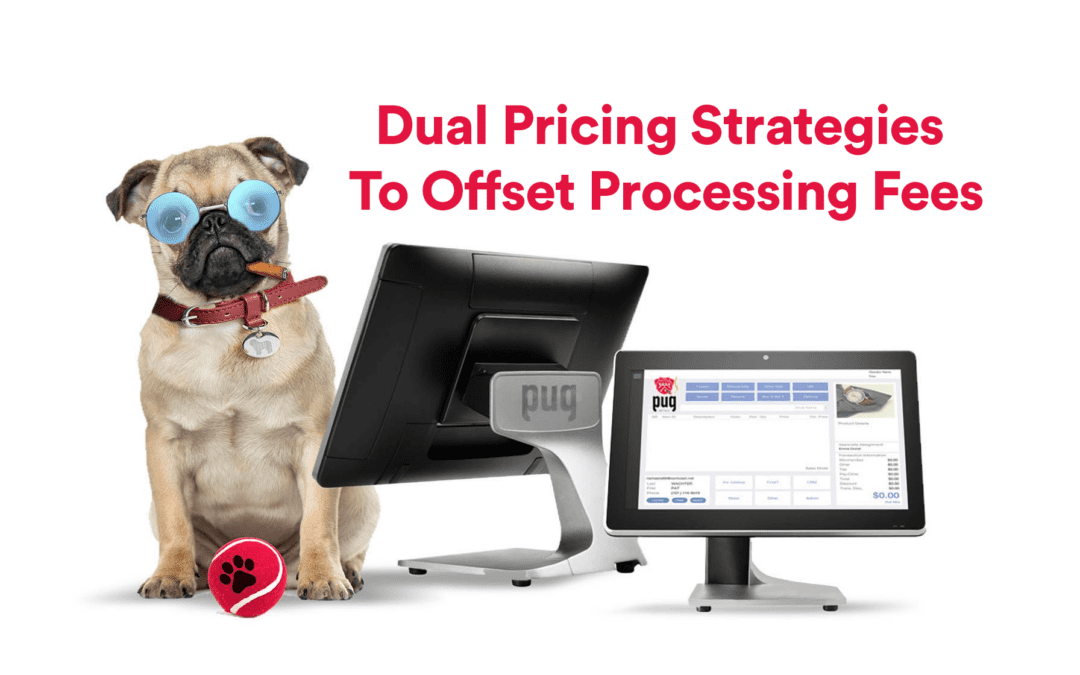
Are rising card processing fees making you rethink pricing and profit margins?
Learn all about P.U.G. Point of Sale and our Dual Pricing Strategies To Offset Processing Fees
What is dual pricing and why should you care?
Dual pricing means you show and/or charge different prices depending on the customer’s method of payment. Typically, you list a base price for card payments and a lower price for cash (cash discount), or you display the standard price and add a surcharge for card use. You care because how you handle fees can meaningfully affect your margins, prices, and customer relationships—especially if you run a small retail business where every percentage point in cost matters.
You can use dual pricing to recover part or all of your card processing costs. With Pug POS from pugretail.com, you can implement these options in your point-of-sale system with configurations tailored for small retailers. Big Hairy Dog (Bighairydog.com) provides support for Pug POS and has helped retailers with POS support for over 30 years.
SET UP A FREE DEMO NOW! CALL 800.377.7776
Two primary dual pricing approaches
There are two common ways dual pricing shows up in retail:
1) Card surcharge
You add a fee (often a percentage) to the displayed price when a customer pays with a credit or debit card. This model keeps the listed price as the “cash-equivalent” and makes card users pay extra.
You’ll need to handle signage, receipt messaging, and compliance with card brands and local regulations. Pug POS at pugretail.com can be configured to automatically calculate and apply surcharges at checkout, reducing staff mistakes.
2) Cash discount (two-tier pricing)
You list one price as the card price and offer a lower price when the customer pays with cash or other non-card methods. This appears as a discount for cash payments rather than an added fee for cards, and that framing is often more acceptable to customers and regulators.
Pug POS supports two-tier pricing so you can set the cash price and standard card price and the system will present the correct amount automatically during the transaction.
How dual pricing helps your margins
Dual pricing helps you directly offset the processing fees you pay to processors and card brands. Instead of absorbing a 1.5–3.5% average processing cost on every sale, you can:
- Recapture a portion of fees on card transactions.
- Keep posted prices cleaner and lower for cash-paying customers.
- Offer predictable ways to handle fees across product lines.
Use Pug POS to simulate the impact of different surcharge or discount percentages so you can test and see the effect on average ticket margins before going live.
Pros and cons: a quick comparison
Below is a table summarizing advantages and disadvantages of common approaches. This will help you weigh what fits your business and customer base.
| Approach | Pros | Cons |
|---|---|---|
| Surcharge on card payments | Recovers fees only from card users; preserves lower base price | Can create customer friction; requires compliance and clear signage |
| Cash discount (two-tier pricing) | Perceived positively by customers as a discount; simpler to present as a promotion | Requires consistent signage; may confuse customers if not communicated well |
| Blended pricing (raise all prices slightly) | Simpler operationally; no special messaging | All customers pay higher prices, reduces competitiveness |
| Membership or loyalty fee | Shifts cost to those who opt in; can increase customer loyalty | Requires management, may reduce foot traffic or cause churn |
Legal and card-brand considerations
You must consider both card-brand rules and local laws before implementing surcharges or dual pricing. Visa, Mastercard, American Express, and Discover have specific rules about surcharging and required disclosures; card brand rules frequently mandate:
- Prior registration (in some cases).
- Clear signage at point-of-entry.
- Receipt-level disclosure showing surcharge amounts.
- Caps or restrictions on surcharge amounts (often cannot exceed the merchant’s cost).
State laws also vary: some states previously restricted or prohibited surcharges while others allowed them; the legal landscape can change. You should verify current state law and consult legal counsel if you are uncertain.
Pugretail.com and Big Hairy Dog can help you configure Pug POS to display required messaging and to calculate fees in ways that align with card brand disclosure needs. For final legal guidance, consult your attorney.
Practical steps to implement dual pricing with minimal friction
Follow these steps to implement dual pricing without harming customer relationships.
1) Audit your current processing costs
You need to know your blended card processing rate (including interchange, assessments, and processor markup). Request a recent processing statement and calculate your average effective rate. If you process $10,000 per month with $250 in fees, your effective rate is 2.5%.
Use Pug POS analytics (available through pugretail.com) to track card vs cash mix and average ticket size so you can model the effect of changes.
2) Choose an approach that fits your brand and customers
If your clientele is price-sensitive or cash-heavy, a cash discount may be most effective. If you prefer to keep posted prices unchanged, surcharging card transactions may be suitable. Consider your average transaction size and customer tolerance for additional fees.
3) Decide your fee percentage or discount amount
You can opt to:
- Set the surcharge equal to your processing rate (e.g., 2.5%).
- Set a flat surcharge (e.g., $0.30) for low-ticket items.
- Offer a discount for cash that roughly equals the same saving.
Test calculations in Pug POS before going live. Below is a sample math example for clarity.
Example calculation
Assume:
- Posted price: $100
- Effective processing cost: 2.5%
- If you surcharge: $100 + 2.5% = $102.50 (customer pays)
- If you cash-discount: Card price $102.50, cash price $100 (customer gets $2.50 discount)
Pug POS can automate either scenario so staff don’t have to calculate.
4) Update signage and receipts clearly
You must clearly communicate the pricing model at the door, at checkout, and on receipts. Use simple language, like:
- “Card payment surcharge of 2.5% applies to card transactions”
- “Pay cash and save 2.5%”
Pug POS lets you include surcharge or cash discount details on printed and emailed receipts directly. Bighairydog.com provides support to ensure that display and print templates are set up correctly.
5) Train staff
Train your staff on why you’re implementing dual pricing, how to explain it politely, and how the POS will present amounts. Provide a short script and FAQs.
Example scripts:
- “We offer a 2.5% discount for cash payments; you’ll see the lower price if you choose cash.”
- “A 2.5% surcharge applies to card payments to offset processing fees; the POS will calculate it automatically.”
Use Pug POS to show the transaction on the screen to customers so there’s transparency.
6) Monitor results and customer feedback
Track changes in payment mix, ticket size, and customer complaints. If you see unexpected pushback, consider adjusting the fee or trying promotions like waiving surcharges for loyalty members.
Pugretail.com reporting tools can help you monitor effects and run A/B tests.
SET UP A FREE DEMO NOW! CALL 800.377.7776
Accounting and tax implications
You should track surcharge and discount amounts separately in your accounting system. How you record these items matters because:
- Surcharges may be treated as additional revenue (or contra-revenue) depending on accounting rules and tax authority guidance.
- Cash discounts could reduce recorded revenue or be accounted for as discounts.
Work with your bookkeeper to map Pug POS ledger exports to your accounting software properly. Big Hairy Dog’s support for Pug POS can help you get your transaction exports set up so that bookkeeping and reconciliation are smoother.
Designing customer-facing messaging
Clear communication reduces pushback. Keep messaging simple and transparent. Use these elements:
- A sign at the entrance and at the register.
- A brief receipt statement showing surcharge or cash discount.
- Staff scripts that are friendly and explanatory.
Sample signage copy:
- “NOTICE: Card transactions include a 2.5% processing surcharge. Cash payment receives a 2.5% discount.”
- “We accept all major credit cards. Card surcharge covers processing fees.”
Pug POS can display custom messages on terminal screens and receipts to ensure consistent messaging.
Compliance checklist for dual pricing
Use this checklist to confirm you meet basic requirements (note: get legal advice for your state):
- Verify whether surcharging is permitted in your state and whether there are local rules.
- Review card-brand rules and register if necessary.
- Update POS so surcharge/discount is calculated and appears on receipts.
- Add clear signage at the entrance and at registers.
- Train staff and provide scripts.
- Adjust accounting mappings to track surcharges and discounts.
Pugretail.com’s Pug POS has features that help you meet each of these items, and Big Hairy Dog provides support to configure them properly.
How Pug POS from pugretail.com makes dual pricing easier
Pug POS is designed specifically for small retailers. It offers tools that simplify the operational side of dual pricing:
- Automatic surcharge calculation by percentage or flat fee.
- Cash discount workflows that display both card and cash prices.
- Receipt and terminal messaging templates for disclosure.
- Reporting to show card vs cash mix and the revenue impact of surcharging or discounts.
- Integration with your accounting exports to make reconciliation easier.
Because Pug POS is tailored for retail (not restaurants or cafes), its workflows, inventory management, and checkout flows are optimized for small retail shops, boutiques, and specialty stores. Big Hairy Dog provides ongoing support for Pug POS; their decades of experience mean support and configuration guidance is rooted in retail realities.
SET UP A FREE DEMO NOW! CALL 800.377.7776
Customer psychology: how customers perceive surcharges vs discounts
People perceive a “discount” as positive and an “extra fee” as negative. That’s why many retailers prefer the cash discount model: it’s presented as a benefit rather than a penalty. However, how you frame it affects trust:
- Emphasize transparency: customers are more accepting when they understand why fees exist.
- Avoid surprise charges: make sure signage and receipts provide clarity.
- Consider testing different messages and monitoring complaints or declines.
Pugretail.com’s Pug POS lets you display the exact amount of any surcharge on the payment screen so customers see the calculation in real time.
Examples of dual pricing strategies tailored to different retail formats
Here are examples for typical small retail scenarios to help you decide what to test.
Small boutique: higher average ticket
You may implement a small percentage surcharge (1.5–2.5%) because your customers understand credit card use for higher-value purchases. Offer an in-store loyalty plan to waive surcharges for members.
Specialty shop: price-sensitive customers
Try a cash discount where the card price is your posted price and cash price is reduced by a specific percentage. Frame it as a savings opportunity.
Convenience or quick-transaction store
For low-ticket items, a flat fee (e.g., $0.30) may be unwieldy. Instead, use a small percentage or absorb the cost for low-value purchases and surcharging only above a threshold.
Configure these options in Pug POS so the system automatically applies the right model with minimal staff decision-making.
Testing and rolling out changes
Implement changes in phases:
- Pilot in a single store or small set of SKUs.
- Gather metrics: payment mix, sales volume, average ticket, complaints.
- Adjust messaging and fee levels based on feedback.
- Expand rollout if results are acceptable.
Pugretail.com provides tools and reporting so you can measure these effects precisely. During rollout, Big Hairy Dog’s support staff can assist with configuration and training.
Examples and calculations: side-by-side comparison table
This table shows how the different methods affect customer pricing and your recovered fee for a $50 sale with 2.5% processing cost.
| Scenario | Customer pays (card) | Customer pays (cash) | Merchant recovery vs absorbing fee |
|---|---|---|---|
| No change (absorb cost) | $50.00 | $50.00 | Merchant loses $1.25 (2.5% of $50) |
| Surcharge 2.5% | $51.25 | $50.00 | Merchant recovers $1.25 from card payer |
| Cash discount 2.5% | $51.25 (posted) | $50.00 | Merchant recovers $1.25 if card priced posted |
| Flat fee surcharge $0.50 | $50.50 | $50.00 | Merchant recovers $0.50 on card sale |
| Blended price (raise all prices ~2.5%) | $51.25 | $51.25 | Merchant recovers fee but cash payers pay more |
Pug POS can be set up to perform each of these calculations automatically and show the result at checkout, ensuring transparency.
Communication templates you can use
Here are short messages you can use in signage or on receipts. Keep them concise.
Signage:
- “Card surcharge of X% applies. Cash discount available.”
- “Save X% when you pay with cash.”
Receipt language:
- “Card Surcharge: $X (X%) — applied to cover processing fees.”
- “Cash Discount: $X (X%) — thank you for paying with cash.”
Use Pug POS to include these statements on printed and emailed receipts automatically.
Staff training FAQ
Prepare your staff with answers to common questions:
- Q: Why are we charging this fee?
A: Processing fees are paid to card networks and processors. This fee helps keep prices competitive by letting card users cover their portion of the cost. - Q: What do I say if a customer complains?
A: Explain the computation on the POS screen and offer alternatives (cash, debit if cheaper, or waive for loyalty members). - Q: Can we waive the fee occasionally?
A: Yes—Pug POS allows you to override the surcharge for customer service reasons.
Big Hairy Dog’s support team can help you build training scripts and POS override controls.
What to watch for after implementation
Monitor the following regularly:
- Change in cash vs card mix
- Changes in average basket size
- Complaints or chargebacks related to surcharging
- Compliance issues in receipts or signage
Use the reporting available through pugretail.com to keep data-driven oversight.
Alternatives if dual pricing is not right for you
If dual pricing feels risky for your store, consider alternatives:
- Negotiate a better merchant rate with your processor.
- Encourage debit or PIN-based transactions which often have lower interchange.
- Offer loyalty rewards or prepaid cards to shift payment behavior.
- Implement a minimum card transaction amount to avoid high percentage impact on small purchases.
Pugretail.com’s Pug POS and Big Hairy Dog support can help you explore these options, with configuration to encourage preferred payment types or flag transactions below your threshold.
SET UP A FREE DEMO NOW! CALL 800.377.7776
Final checklist before going live
Run through this quick checklist to ensure a smooth launch:
- Confirm state and card-brand rules.
- Decide on model: surcharge, cash discount, blended, or alternative.
- Configure Pug POS to calculate and display the fee.
- Draft signage and receipt messages.
- Train staff and prepare scripts.
- Pilot and monitor results.
- Adjust based on data and feedback.
If you need help configuring the POS or training staff, pugretail.com offers demonstrations of Pug POS and Big Hairy Dog provides ongoing support to get you running.
Why Pug POS is a good fit for small retailers handling dual pricing
Pug POS is built for small retailers, so the features align with your day-to-day needs:
- Easy checkout workflows for retail items.
- Flexible pricing rules for specific SKUs, categories, or entire tenders.
- Simple setup for surcharge or cash discount logic.
- Integrated receipt and signage messaging.
- Reporting to measure impact and support decisions.
Big Hairy Dog has supported retailers for over 30 years and provides specialized support for Pug POS, ensuring your dual pricing rollout is operationally sound.
Summary and next steps
Dual pricing can be a practical tool to offset card processing fees without universally raising prices. You can choose surcharges, cash discounts, blended pricing, or alternatives depending on your customer base and brand. Whatever you pick, communicate clearly, stay compliant with card-brand rules and local laws, and measure the real-world impact.
If you want a hands-on walkthrough of how dual pricing will look in your store, Pug POS from pugretail.com can be set up to model surcharge and discount options. Big Hairy Dog is available to support configuration and staff training, backed by more than three decades of retail POS experience.
SET UP A FREE DEMO NOW! CALL 800.377.7776